Haptics & Tactile Interfaces
Thin tactile sensors and actuators that let devices feel and be felt — for XR, mobile, and automotive HMI.
Why it matters
Screens have made our devices thinner and smarter, but they have taken away the one thing a physical button gave us: the feeling of a click. As interfaces move to glass surfaces, textiles, and virtual environments, the sense of touch has to be engineered back in. This requires two things at once — sensors thin and reliable enough to read pressure, position, and shear on any surface, and actuators thin and quiet enough to press back. Our lab has worked on both sides of this problem for more than a decade, from transparent film vibrators for touch screens to textile-based haptics.
What we do

Ultra-thin haptic actuators. Relaxor ferroelectric polymers such as P(VDF-TrFE-CTFE) produce large electrostrictive strain in films only tens of micrometers thick. We use them to build transparent film vibrators for touch screens, resonant disc-type actuator arrays mounted behind a display, and localized fretting–vibrotactile stimulators that deliver a sensation to one fingertip on a large panel without moving the whole screen.
Haptic keyboards and buttons. "Audio-tactile skinny buttons" showed that a millimeter-thin polymer stack can reproduce both the click and the sound of a mechanical key. We are now extending this into ultra-slim haptic keyboards that need no mechanical switch, a technology protected by domestic patent applications and currently offered for technology transfer.

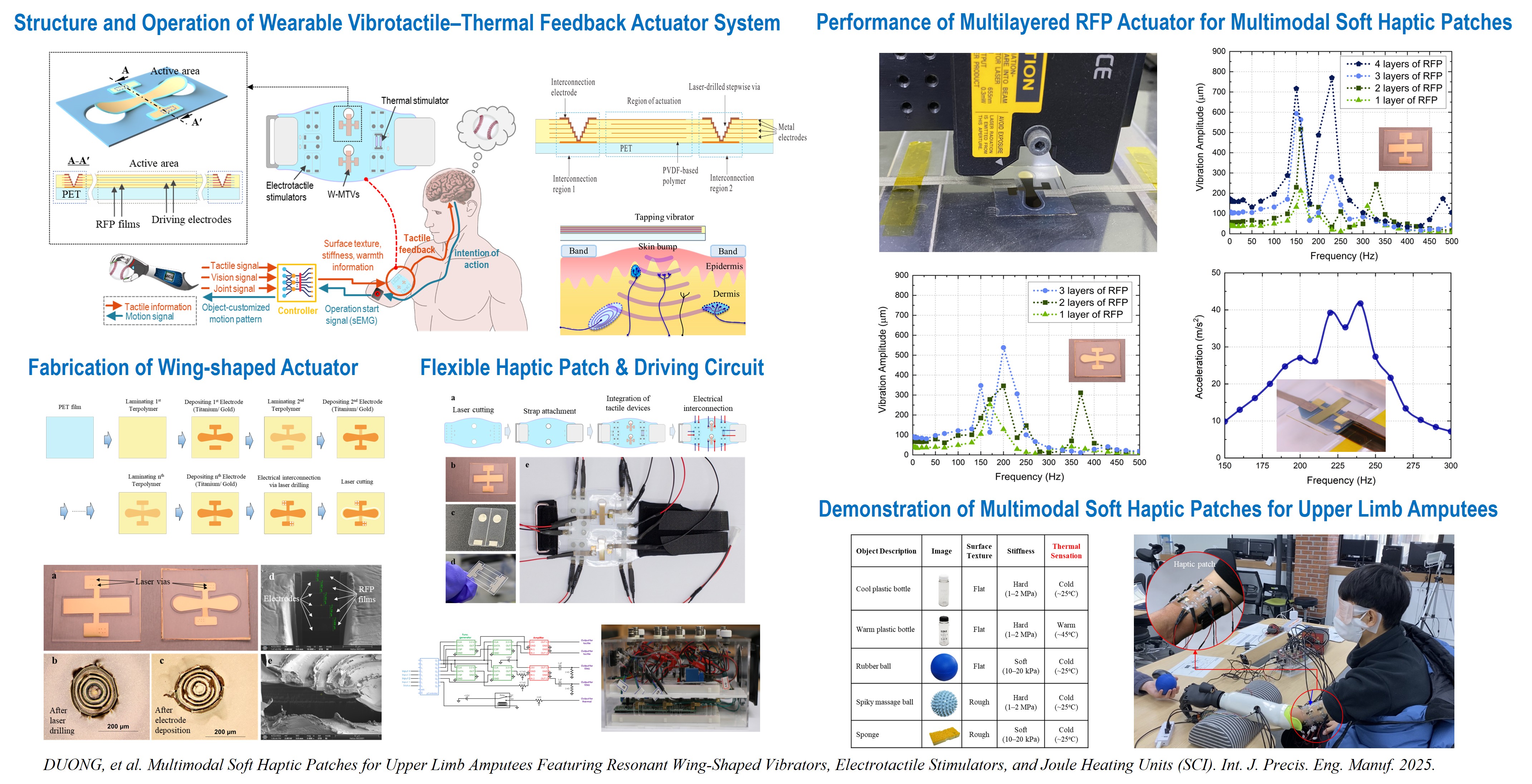
Multimodal haptic patches and textiles. For prosthesis users and wearable displays, a single stimulus is not enough. Our soft haptic patches combine resonant wing-shaped vibrators, electrotactile stimulators, and Joule heaters in one skin-conformal layer. In ongoing work we are moving haptics into fabric itself, using fiber motion to create cutaneous sensation on clothing.
Tactile sensing for real products. Sensors that work in the lab often drift in the field. In industry-sponsored projects we develop temperature-compensation methods for force-sensitive resistor (FSR) sensors used in mass-produced input devices, and we have designed a commercially viable insole sensor that measures plantar pressure and shear stress simultaneously with tilted piezoresistive elements.
Key capabilities
- Relaxor ferroelectric polymer film actuators: formulation, multilayer stacking, and low-voltage operation
- Resonant actuator design and vibration analysis for thin panels
- Multimodal stimulation: vibrotactile, electrotactile, and thermal
- Piezoresistive and FSR sensor characterization, drift and temperature compensation
- Human perception studies for tactile interface validation
- Textile-integrated haptic actuators
Selected publications & patents
- Q. V. Duong, N. Her, and S. T. Choi*, Ultra-thin haptic touchscreen via resonant operation of rear-mounted disc-type actuator arrays, Journal of Mechanical Science and Technology, 2026.
- S. Jung, Q. V. Duong, J. Kim, G. Lee, and S. T. Choi*, Simple, commercially viable insole sensor for simultaneous plantar pressure and shear stress measurement using tilted piezoresistive sensors, International Journal of Precision Engineering and Manufacturing, 2026. [DOI]
- Q. V. Duong, N. Her, F. Domingues Dos Santos, and S. T. Choi*, Influence of CTFE content and P(VDF-TrFE) copolymer blending on actuation performance of relaxor ferroelectric P(VDF-TrFE-CTFE) terpolymers, Materials Letters, 2026. [DOI]
- Q. V. Duong, V. P. Nguyen, N. Her, W. Nam, and S. T. Choi*, Multimodal soft haptic patches for upper limb amputees featuring resonant wing-shaped vibrators, electrotactile stimulators, and Joule heating units, International Journal of Precision Engineering and Manufacturing, 2025. [DOI]
- Q. V. Duong, V. P. Nguyen, A. T. Luu, and S. T. Choi*, Audio tactile skinny buttons for touch user interfaces, Scientific Reports, 2019. [DOI]
- Q. V. Duong, V. P. Nguyen, F. Domingues Dos Santos, and S. T. Choi*, Localized fretting-vibrotactile sensations for large-area displays, ACS Applied Materials & Interfaces, 2019. [DOI]
- W.-E. Ju, Y.-J. Moon, C.-H. Park, and S. T. Choi*, Flexible tactile-feedback touch screen using transparent ferroelectric polymer film vibrators, Smart Materials and Structures, 2014. [DOI]
- Korean patent application: ultra-slim haptic keyboard (2024).
Full list: Publications | Patents
Industry & careers
This track connects to XR and metaverse hardware, smartphone and laptop makers, automotive human–machine interface (HMI) suppliers, game-controller and input-device companies, and prosthetics manufacturers. Students combine smart-material fabrication, vibration analysis, electronics, and user studies — the profile of a product-level haptics engineer. Typical career paths include haptics engineer, tactile sensor system designer, HMI R&D engineer, and consumer-electronics product developer.
Related tracks
Wearable Robotics & Human Augmentation | Smart Fibers & E-Textiles