Wearable Robotics & Human Augmentation
Soft actuators and clutches that assist the human body — for rehabilitation, industrial, and defense wearables.
Why it matters
Rigid exoskeletons can lift heavy loads, but they are bulky and tiring to wear for a full day. Soft wearables are comfortable, but most cannot produce useful force. As populations age and workers in logistics, manufacturing, and defense face growing physical demands, there is a clear need for assistive devices that sit in between: light enough to forget you are wearing them, yet strong enough to make a difference. Our lab develops the actuators, clutches, and sensors that make such devices possible.
What we do
Assistive exo-glove. We are developing a lightweight glove that supports the grip of people with weakened hands. A compact electroadhesive clutch holds tendon cables in place with very little power, and muscle-signal (sEMG) sensors embroidered directly into textile read the user's intent, so that assistance is delivered when and where it is needed. The design goal is a device that can be worn all day, not only in the clinic.
High-speed cryogenic-gas actuators. Conventional pneumatic wearables need a compressor. We have developed an actuator that generates high pressure from the rapid expansion of a low-temperature liquefied gas, enabling strong and fast strength assistance from a small, tether-free package. The concept is protected by domestic patent applications.
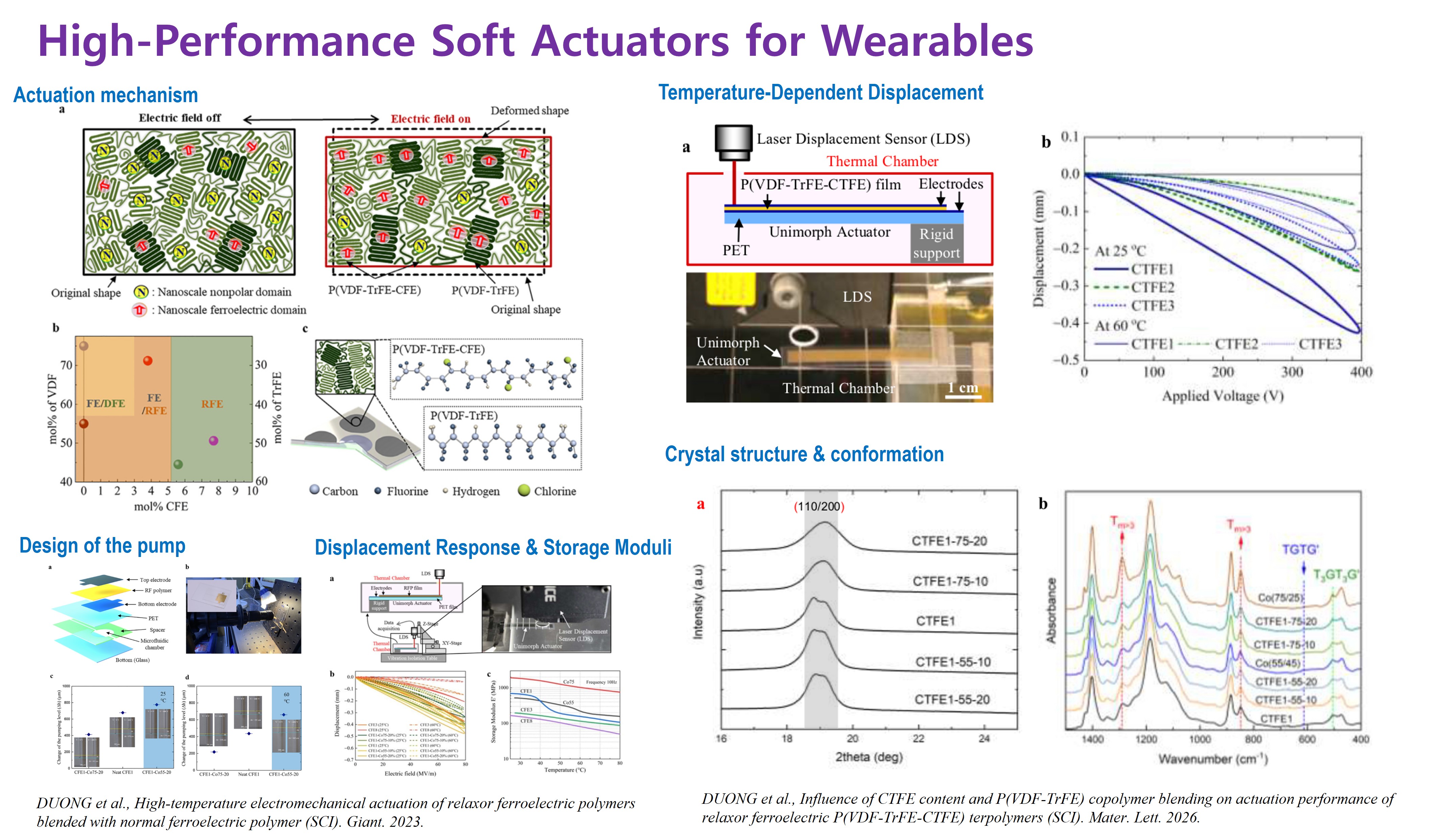
Electroactive polymer (EAP) artificial muscles. Relaxor ferroelectric polymers such as P(VDF-TrFE-CTFE) produce electric-field-induced strains far larger than piezoceramics. We tailor their composition and blending to improve actuation strain, force, and operating temperature, and we build multilayer actuators that operate at reduced voltage — the building blocks for thin, silent, and lightweight wearable actuation.
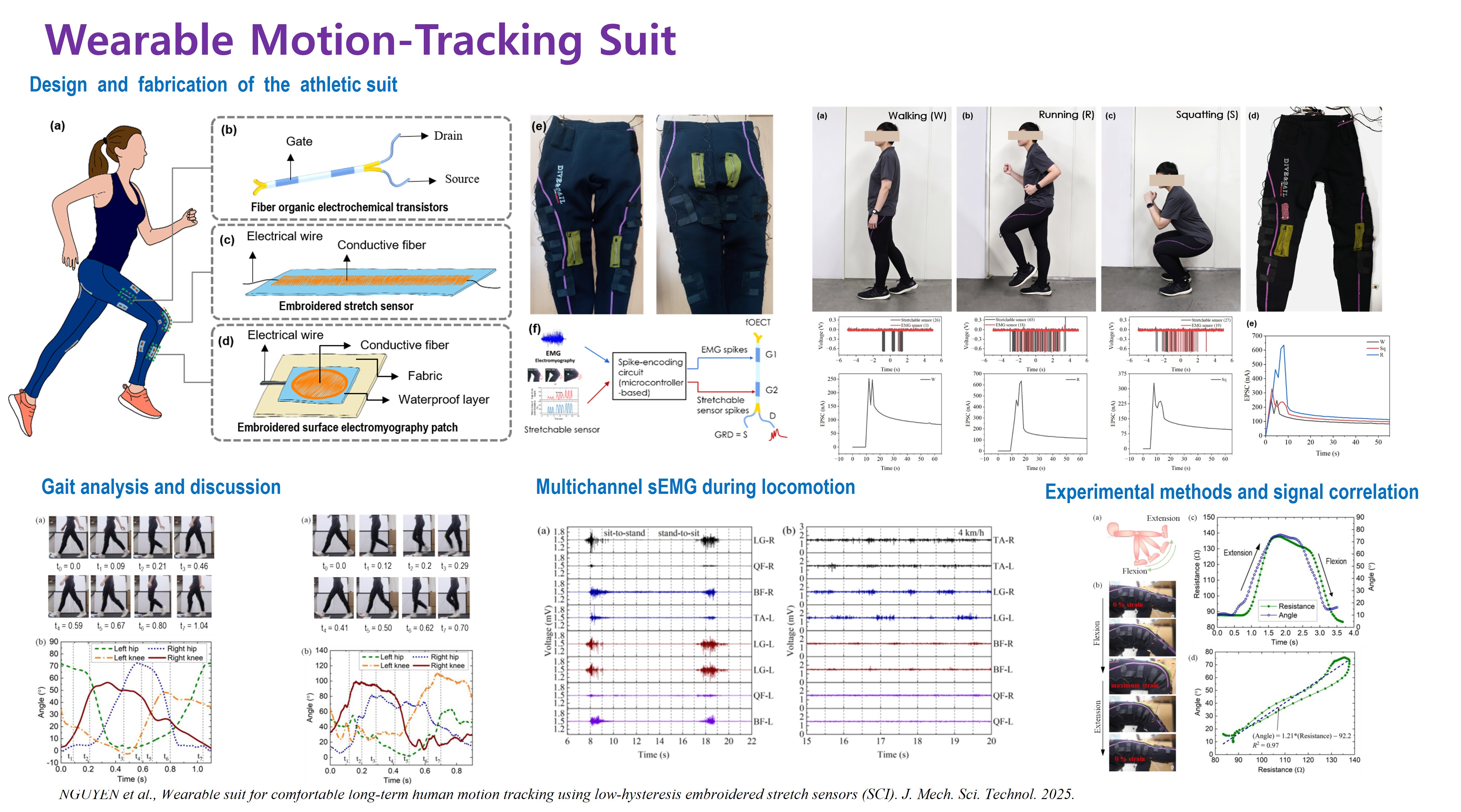
Fiber actuators and motion-sensing textiles. Using our thermal drawing facility we produce polymer fiber actuators whose geometry can be programmed during manufacturing, and we embroider low-hysteresis stretch sensors into garments for comfortable, long-term tracking of human motion — the sensing layer that closes the loop for any wearable robot.
Key capabilities
- Electroadhesive (EA) jamming clutches and tendon-driven soft mechanisms
- Embroidered textile sEMG and stretch sensors; intent-based control
- Relaxor ferroelectric polymer actuator fabrication and characterization
- Cryogenic-gas cylinder and Bowden-cable transmission for strength assistance
- Thermally drawn polymer fiber actuators
- Wearer trials and biomechanical evaluation
Selected publications & patents
- Q. V. Duong, N. Her, F. Domingues Dos Santos, and S. T. Choi*, Influence of CTFE content and P(VDF-TrFE) copolymer blending on actuation performance of relaxor ferroelectric P(VDF-TrFE-CTFE) terpolymers, Materials Letters, 2026. [DOI]
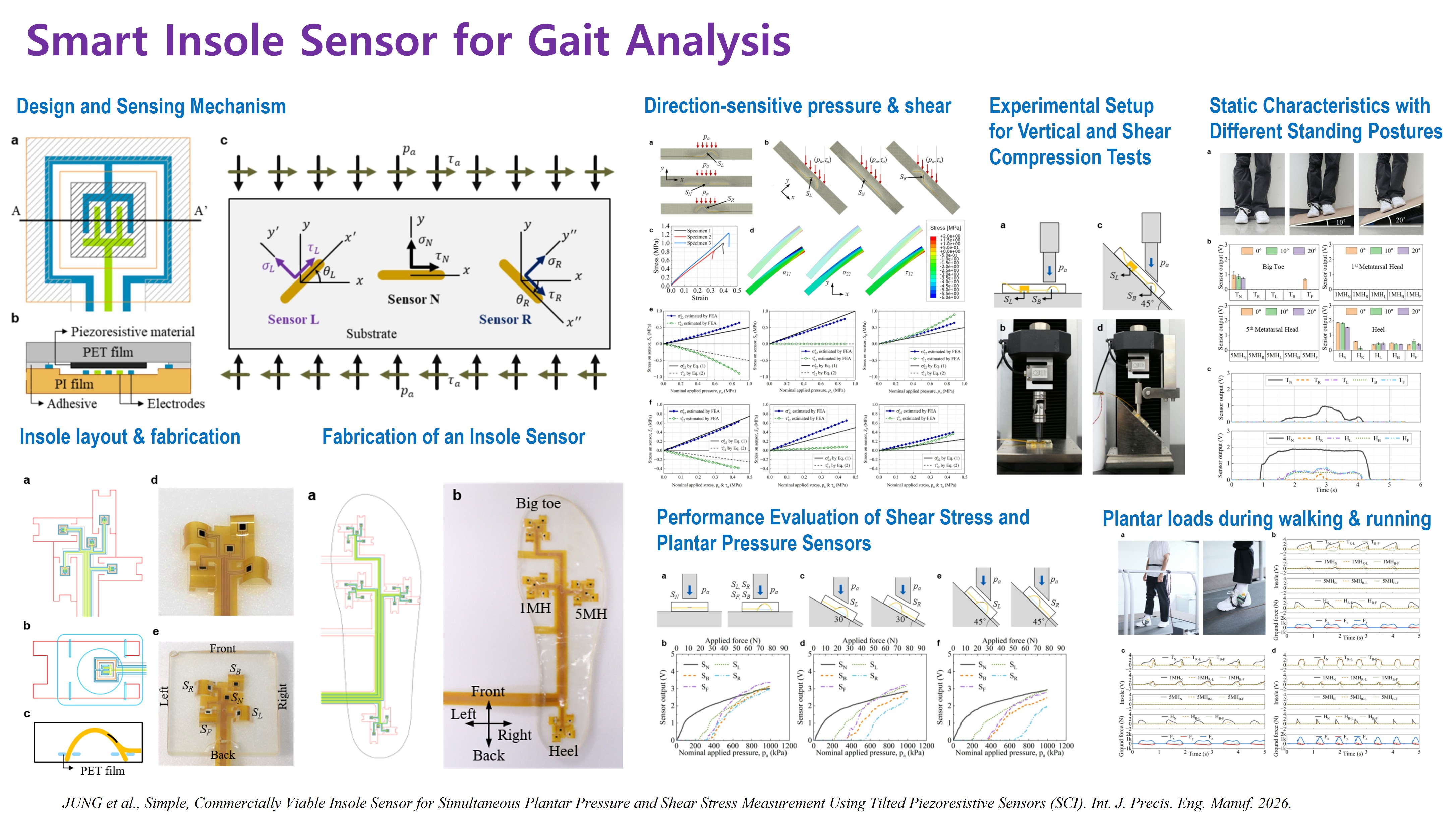
- S. Jung, Q. V. Duong, J. Kim, G. Lee, and S. T. Choi*, Simple, commercially viable insole sensor for simultaneous plantar pressure and shear stress measurement using tilted piezoresistive sensors, International Journal of Precision Engineering and Manufacturing, 2026. [DOI]
- G. T. Nguyen, J. Lee, S. Jung, and S. T. Choi*, Wearable suit for comfortable long-term human motion tracking using low hysteresis embroidered stretch sensors, Journal of Mechanical Science and Technology, 2025. [DOI]
- Q. V. Duong, V. P. Nguyen, N. Her, W. Nam, and S. T. Choi*, Multimodal soft haptic patches for upper limb amputees featuring resonant wing-shaped vibrators, electrotactile stimulators, and Joule heating units, International Journal of Precision Engineering and Manufacturing, 2025. [DOI]
- Q. V. Duong, C. Park, Y. Lee, S. Lee, T. T. Nguyen, V. P. Nguyen, F. Domingues Dos Santos, C. Park*, and S. T. Choi*, High-temperature electromechanical actuation of relaxor ferroelectric polymers blended with normal ferroelectric polymer, GIANT, 2024. [DOI]
- Y. Cho, G. T. Nguyen, Q. V. Duong, and S. T. Choi*, Time-evolution of electrical resistance–strain hysteresis curve of embroidered stretch sensors and their application in reliable human motion tracking, Journal of Mechanical Science and Technology, 2022. [DOI]
- S. T. Choi*, J. O. Kwon, and F. Bauer, Multilayered relaxor ferroelectric polymer actuators for low-voltage operation fabricated with an adhesion-mediated film transfer technique, Sensors and Actuators A: Physical, 2013. [DOI]
- Korean patent applications: high-speed actuator driven by low-temperature vaporized gas and wearable strength-assist device (2023); assistive exo-glove with electroadhesive clutch (2026).
Full list: Publications | Patents
Industry & careers
This track connects to rehabilitation and assistive-device companies, wearable-robot developers for industrial and defense use, medical-device manufacturers, and robotics divisions of large manufacturers. Students gain hands-on experience across mechanism design, soft-material fabrication, embedded sensing, and human-subject testing. Typical career paths include soft-robotics system engineer, actuator and mechanism developer, wearable device R&D engineer, and human–robot interface engineer.
Related tracks
Smart Fibers & E-Textiles | Haptics & Tactile Interfaces