2026. 05. 21 – Our paper on cladding-free thermal drawing of piezoelectric PVDF fibers has been published in npj Flexible Electronics!!
Jongseok LEE (first author, Ph.D. course), Thinh Tam LUONG (MS), Namhun HER (Ph.D. course), Seungmin LEE (MS), and Dr. Quang Van DUONG, supervised by Prof. Jeongbin IN, Prof. Sangmin LEE, Prof. Seung-Hwan CHANG, and Prof. Seungtae CHOI (corresponding author), have published their work in npj Flexible Electronics (Nature Partner Journals, IF 15.5, JCR top 1.5%) on May 21, 2026.
Paper: Cladding-free thermal drawing for scalable reel-to-reel manufacturing of piezoelectric coaxial polyvinylidene fluoride fibers
DOI: https://doi.org/10.1038/s41528-026-00590-0
CAU News: 공과대학 기계공학부 최승태 교수 연구팀, 열인발 공정 기반 동축 압전 PVDF 섬유 대량생산 기술 개발
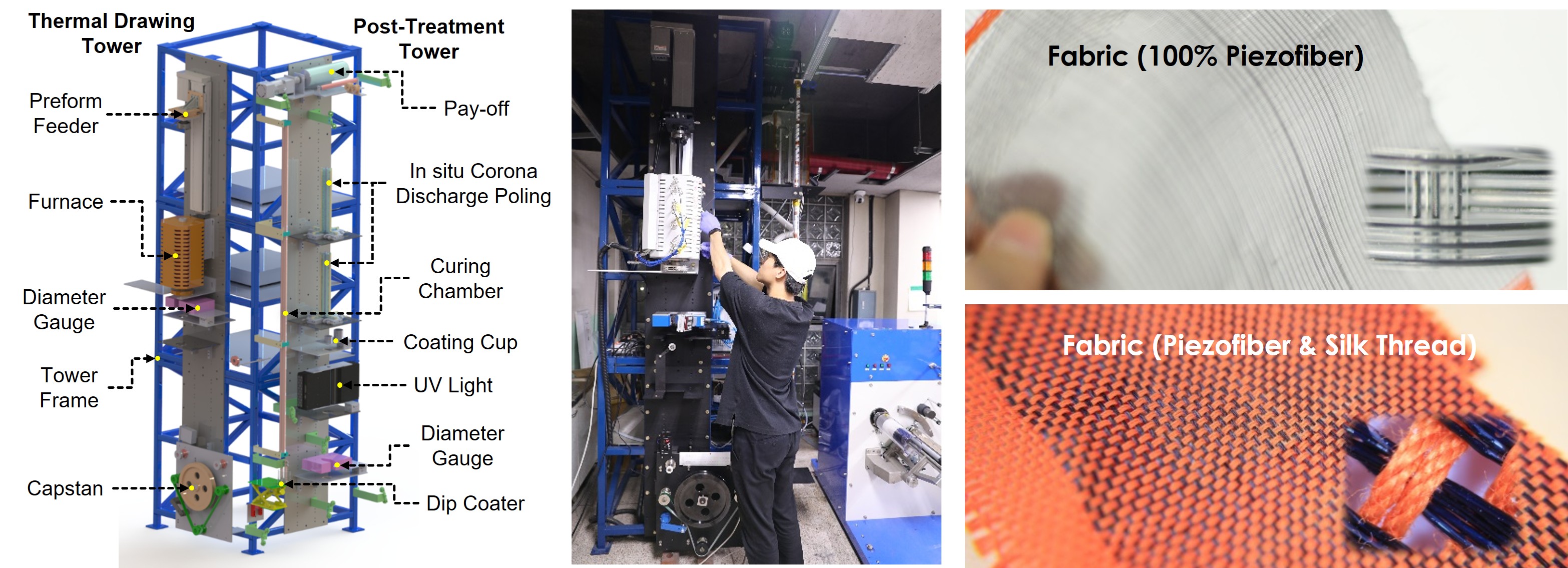
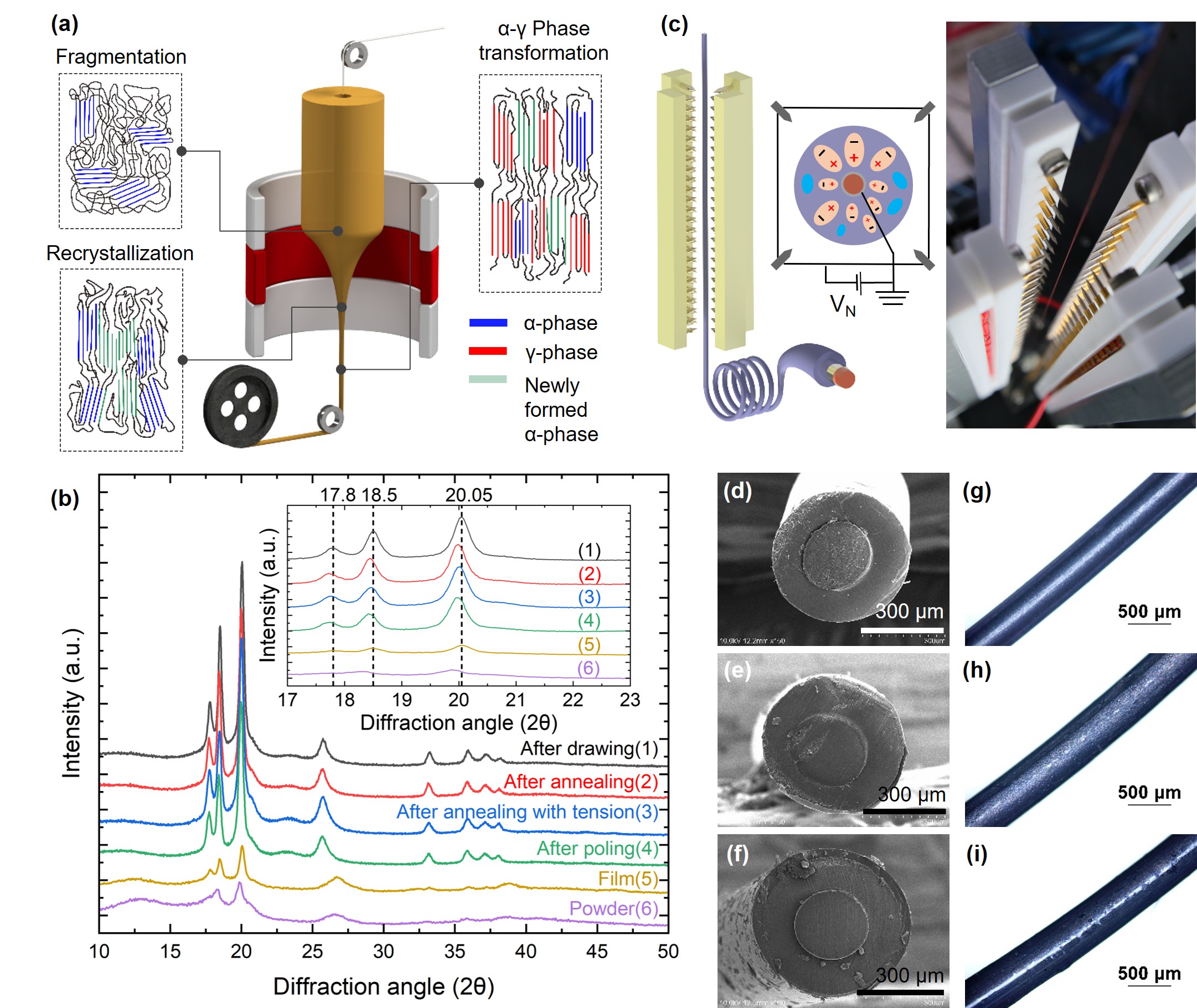
Thermal drawing can produce hundreds of meters of functional fiber from a single preform, but two bottlenecks have kept it from becoming a mass-production route for piezoelectric fibers. First, semi-crystalline polymers such as PVDF lose viscosity sharply on melting and break easily during drawing, so a cladding layer has been considered indispensable; that cladding must be removed afterward and blocks in-line post-processing such as corona poling. Second, no electrode has been both flexible and conductive enough to be co-drawn as a fiber core.
We solved both problems. A newly developed Thermal Elongation (TE) test, which directly observes tensile deformation and rupture near the melting point, revealed the narrow temperature–load window (around 155 °C) in which PVDF can be drawn stably without any cladding. A nylon monofilament coated with silver nanowires (~17 Ω/cm) serves as a flexible, highly conductive core electrode fed into the fiber center during drawing. Because the fiber comes off the draw tower bare, poling, dip-coating of the outer electrode, and die-coating of the protective layer run continuously in a single reel-to-reel line.
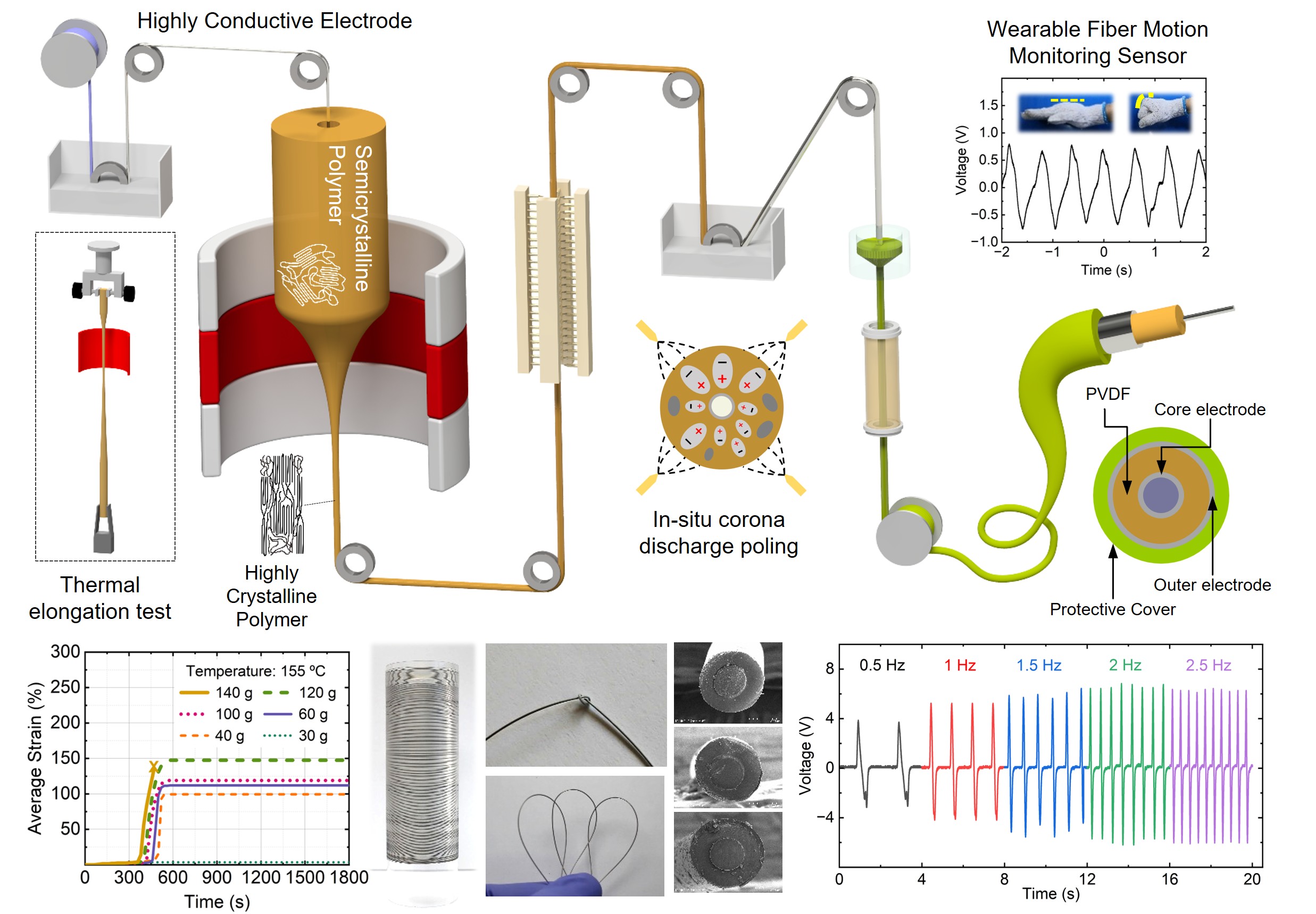
The resulting coaxial fibers generate 9.4 V at only 0.5% tensile strain—well above conventionally drawn PVDF fibers (hundreds of mV to ~2 V)—and retain about 87% of their initial output after 10,000 bending cycles at a 1 mm radius. Sewn directly into a cotton glove, the fibers track finger motion in real time, demonstrating a practical smart-glove application.
Congratulations to all the authors~!!