Smart Fibers & E-Textiles
Fibers that sense and actuate, and the processes to manufacture them — for smart apparel and health-monitoring wearables.
Why it matters
Clothing is the one device we already wear all day. If a sensor or actuator can be made in the form of a fiber, it can be woven, knitted, or sewn with ordinary textile machinery and disappear into a shirt, a glove, or a sock. The obstacle has never been the idea but the manufacturing: laboratory demonstrations are made a few centimeters at a time, while the textile industry needs kilometers of consistent fiber at low cost. Our lab works on exactly this gap — the materials, the fiber architectures, and the continuous processes that turn functional polymers into textile-grade fibers.
What we do
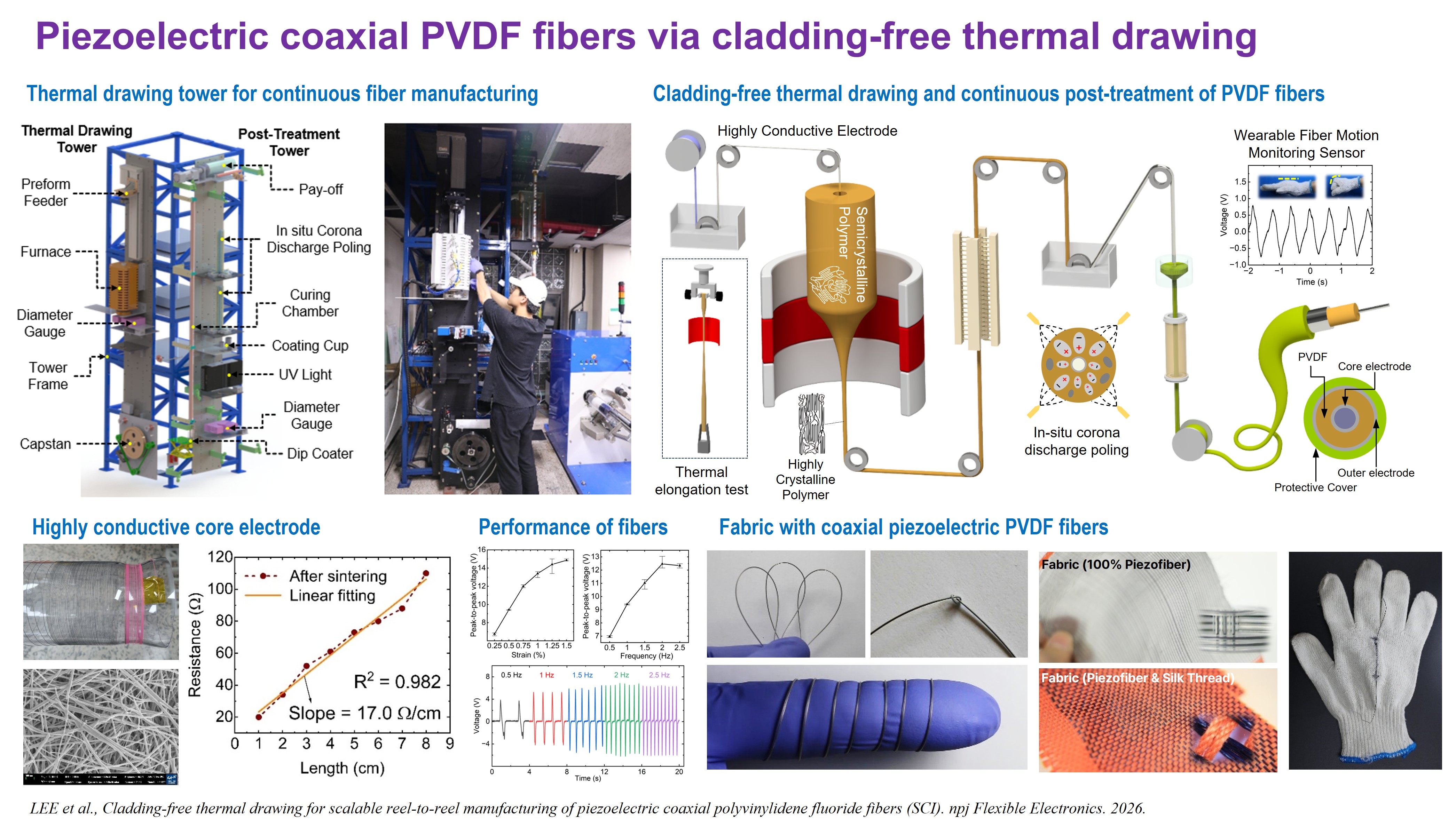
Thermal drawing of functional fibers. Thermal drawing scales a macroscopic preform down to hundreds of meters of fiber while preserving its cross-sectional design, so electrodes, piezoelectric layers, and protective jackets can all be built into the preform and drawn at once. Our lab operates a custom drawing tower and has established the processing windows for polymers such as PVDF that were long considered too difficult to draw without a sacrificial cladding.
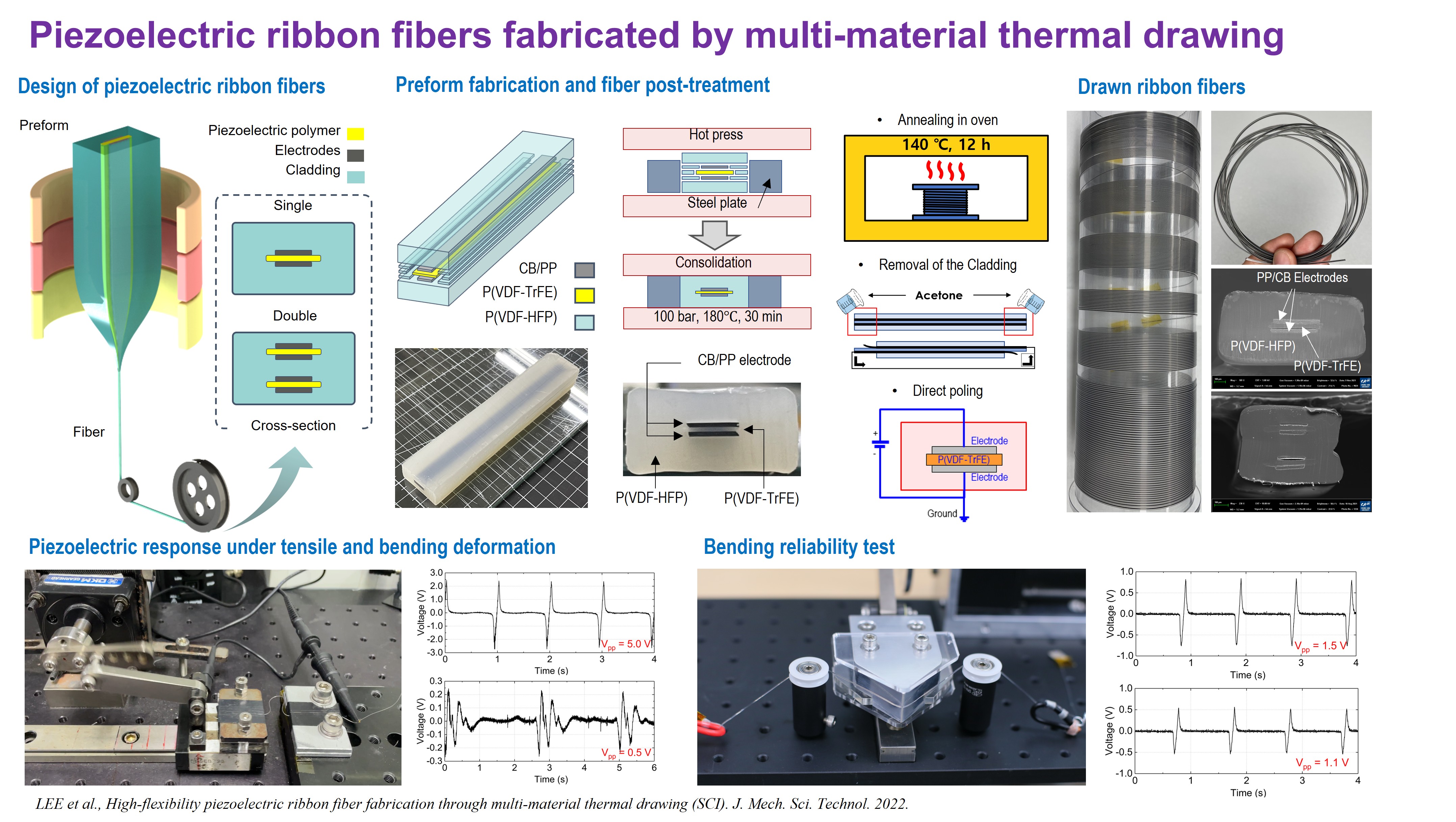
Piezoelectric fibers for sensing and energy harvesting. Our recent work in npj Flexible Electronics (2026) introduced a cladding-free process for coaxial PVDF fibers with a silver-nanowire-coated core electrode, enabling poling and electrode coating to run continuously in a single reel-to-reel line. The resulting fibers generate 9.4 V at 0.5 % strain and survive 10,000 bending cycles, and can be sewn directly into a glove to track finger motion. Earlier work produced high-flexibility piezoelectric ribbon fibers by multi-material drawing and demonstrated wearable cloth made of PVDF fibers.
Fiber-shaped electronics and energy storage. Beyond sensing, we work on fibers that store energy and process signals — including laser-assisted monofilament fiber supercapacitors and, in ongoing work, fiber-based electrochemical transistors that place circuit elements directly on a continuous fiber backbone.
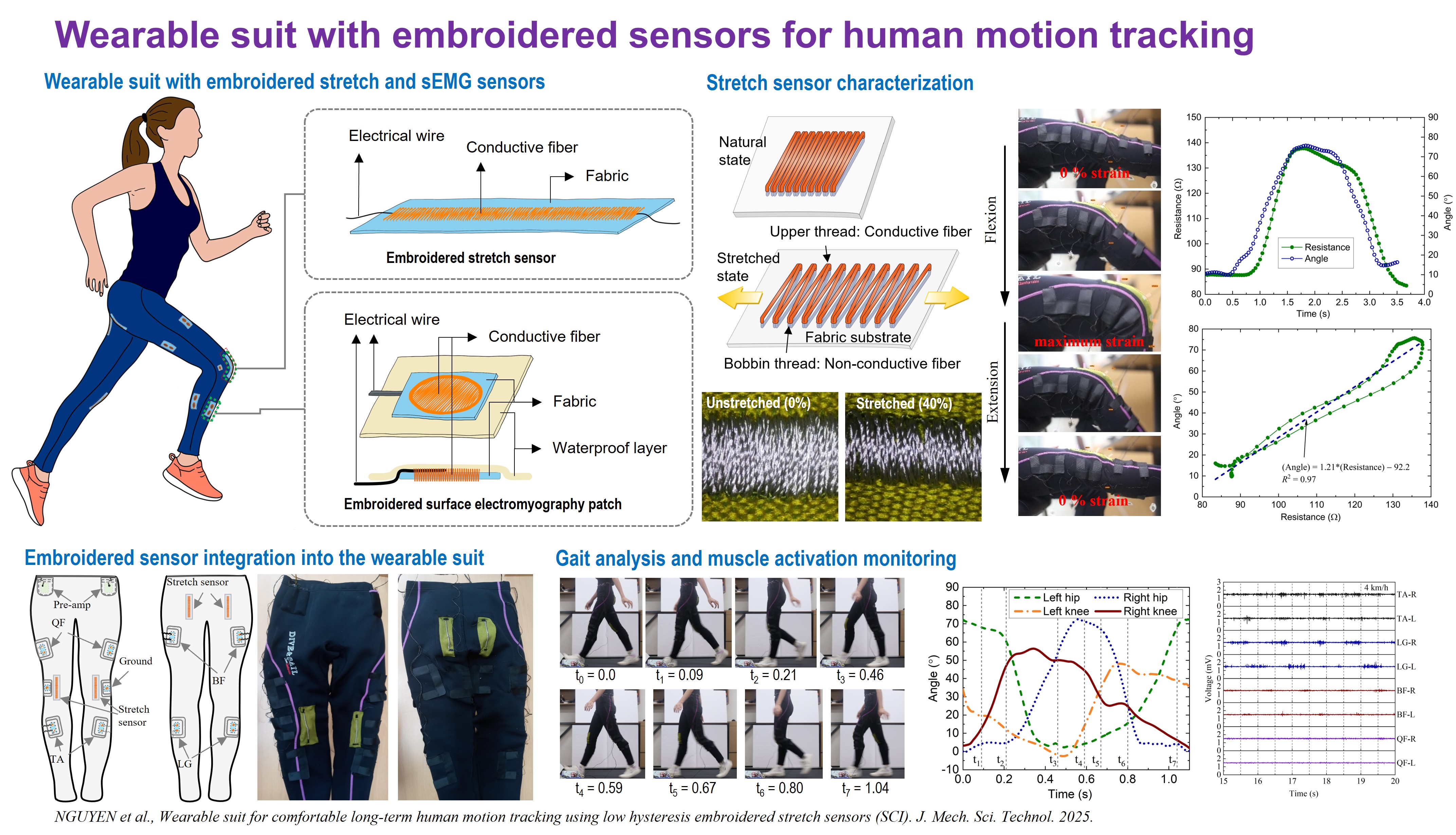
Embroidered e-textiles. Not every function needs a new fiber. We also embroider stretch and muscle-signal sensors into garments with commercial conductive yarns, and study how their electrical response evolves with use so that motion-tracking suits remain reliable over long-term wear.
Ongoing directions. Stretchable and biodegradable piezoelectric fibers for skin-contact and implantable sensors, and single fibers that report both the magnitude and the position of a touch.
Key capabilities
- Thermal drawing tower with in-line corona poling, dip-coating, and die-coating
- Thermal Elongation (TE) test for polymer processability near the melting point
- Preform design and multi-material co-drawing (polymer, electrode, jacket)
- Conductive core electrodes (AgNW-coated nylon) and stretchable electrode coatings
- Piezoelectric, piezoresistive, and electrochemical fiber devices
- Embroidery-based e-textile fabrication and long-term reliability testing
Selected publications & patents
- J. Lee, T. T. Luong, N. Her, S. Lee, Q. V. Duong, J. B. In, S. Lee, S. H. Chang, and S. T. Choi*, Cladding-free thermal drawing for scalable reel-to-reel manufacturing of piezoelectric coaxial polyvinylidene fluoride fibers, npj Flexible Electronics, 2026. [DOI]
- G. T. Nguyen, J. Lee, S. Jung, and S. T. Choi*, Wearable suit for comfortable long-term human motion tracking using low hysteresis embroidered stretch sensors, Journal of Mechanical Science and Technology, 2025. [DOI]
- I.-J. Jung, S. T. Choi, and S.-H. Chang*, Experimental feasibility investigation of wearability of cloth-type electronic devices composed of functional polyvinylidene difluoride (PVDF) fibers, Composite Structures, 2023. [DOI]
- S. Lee, Q. V. Duong, N. Her, A. T. Luu, N. T. Lam, and S. T. Choi*, High-flexibility piezoelectric ribbon fiber fabrication through multi-material thermal drawing, Journal of Mechanical Science and Technology, 2022. [DOI]
- Y. Cho, G. T. Nguyen, Q. V. Duong, and S. T. Choi*, Time-evolution of electrical resistance–strain hysteresis curve of embroidered stretch sensors and their application in reliable human motion tracking, Journal of Mechanical Science and Technology, 2022. [DOI]
- P. T. Nguyen, J. Jang, Y. Lee, S. T. Choi, and J. B. In*, Laser-assisted fabrication of flexible monofilament fiber supercapacitor, Journal of Materials Chemistry A, 2021. [DOI]
- C.-H. Park, Q. V. Duong, Y.-J. Moon, K. Ha, and S. T. Choi*, Enhanced thermo-electro-mechanical characteristics of purified P(VDF-TrFE) films for ultrasonic transducers, Sensors and Actuators A: Physical, 2018. [DOI]
- [Patents on functional fiber manufacturing — to be added]
Full list: Publications | Patents
Industry & careers
This track connects to smart apparel and sportswear brands, health-monitoring wearable companies, textile and fiber manufacturers, and flexible-electronics firms. Students learn polymer processing, fiber and preform design, device fabrication, and reliability testing — a combination that is rare and increasingly sought after. Typical career paths include functional-material process engineer, wearable sensor developer, textile electronics R&D engineer, and fiber and polymer product engineer.
Related tracks
Wearable Robotics & Human Augmentation | Haptics & Tactile Interfaces